
 بله
بله
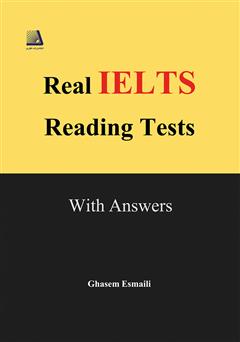
کتاب Real IELTS Reading Tests With Answers تألیف قاسم اسماعیلی، شامل مجموعهای از 60 آزمون ریدینگ آیلتس در سال 2017 با پاسخ کامل میشود. این کتاب برای کسانی است که قصد دارند در این امتحان شرکت کنند و خواهان قبولی با نمرهی 6-7.5 یا بالاتر هستند.
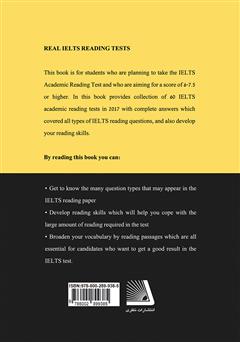
This book is for students who are planning to take the IELTS Academic Reading Test and who are aiming for a score of 6-7.5 or higher. In this book provides collection of 60 IELTS academic reading tests in 2017 with complete answers which covered all types of IELTS reading questions, and also develop your reading skills
The book is divided into two sections, in first section, there are four hard reading 2017 with answer explanations. Second Section In this book provides collection of 60 real academic reading tests in 2017 for IELTS with complete answers, which covered all types of IELTS reading passages. and a reading exam to test your skills. At the end of this book provides a list of most frequent Academic words for improve your IELTS vocabulary
,By reading this book you can: Get to know the many question types that may appear in the IELTS reading paper Develop reading skills which will help you cope with the large amount of reading required in the test, Broaden your vocabulary by reading passages which are all essential for candidates who want to get a good result in the IELTS test
The International English Language Testing System (IELTS) is widely recognized as a reliable means of assessing the language ability of candidates who need to study or work where English is the language of communication
A variety of question types is used, including: multiple choice, identifying information (true/false/Not Given), identifying writers/claim (Yes/No Not Given), matching information, matching headings, matching features, matching sentence ending, sentence completion, summary completion, note completion, table completion, flow- chart completion, diagram label completion, short –answer questions
در بخشی از کتاب Real IELTS Reading Tests With Answers میخوانیم:
Perhaps the most intriguing feature of honeybee communication is a series of flight moves only performed by a female worker bee that has returned to the nest with nectar and needs to tell the rest of her colony that she has discovered food supplies and where they can be found. This so-called honeybee dance was first interpreted by German zoologist Karl von Frisch in the early 1970s. To facilitate observation, von Frisch and his students built several glass walled hives and marked a collection of worker bees, or foragers, with paint. He then trained those foragers to find nectar at designated sources at various distances from the hives, and when the bees returned he carefully recorded their movements, the angle and direction of their flight, and any additional visual cues offered to the colony. What von Frisch discovered was that each aspect of the dance indicated certain details about the location of the nectar reserves and recruited others to return to the site
The first piece of information conveyed by dancing bees is the distance of the field to the hive, and they do this in one of three ways. If it is less than 50 meters from the colony’s nest the bee will fly around in narrow circles, and then suddenly fly in the opposite direction. She will repeat this pattern, which von Frisch’s team called the round dance, until she has recruited several other workers to return with her to the field. When the distance is greater than 50 meters, but less than 150 meters, she will perform a sickle dance, a crescent shaped flight course. If the field is farther than 150 meters, the forager will act out a waggle dance in which she will run straight ahead briefly before returning to her original position in a semi-circular movement. Then, she will run forward again and return from the opposite side. The length of the forward run coincides with the distance of the food supplies; for example, a 2.5 second run indicates that the nectar was found about 2500 meters way